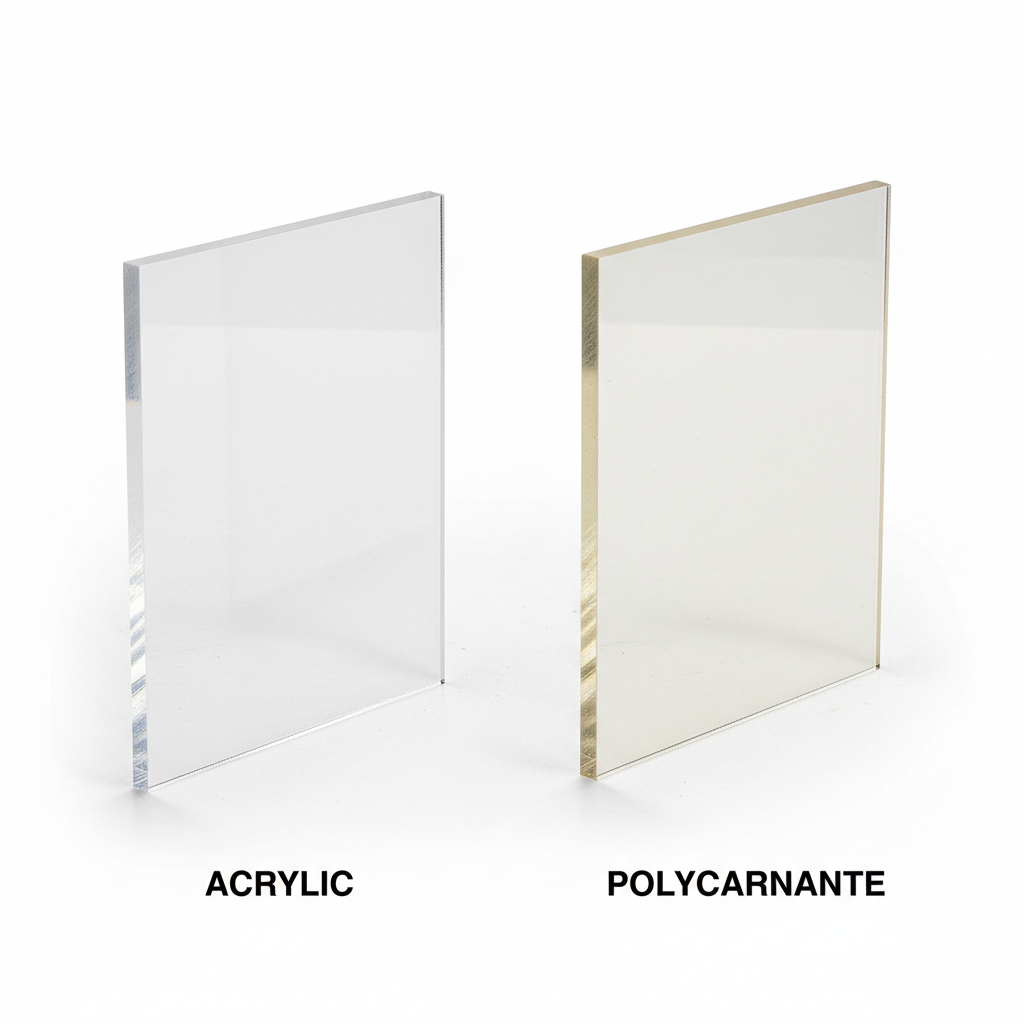
Acrylic vs Polycarbonate: Which Clear Plastic Should You CNC Cut?
We get this question at least once a week: "Should I use acrylic or polycarbonate?" Both materials are transparent, both can be CNC cut, and both are significantly lighter than glass. But they have very different properties that make each one better suited for specific applications.
Here's the practical breakdown from a CNC cutting perspective.
At a Glance: Key Differences
| Property | Acrylic (PMMA) | Polycarbonate (PC) | |---|---|---| | Clarity | 92% light transmission | 88% light transmission | | Impact resistance | Moderate — can shatter | Virtually unbreakable | | Scratch resistance | Better | Worse (scratches easily) | | UV resistance | Excellent — won't yellow | Poor — yellows without coating | | CNC edge quality | Excellent — near polished | Good — requires more finishing | | Cost | $$ | $$$ (30-50% more) | | Max continuous temp | 160°F (70°C) | 240°F (115°C) | | Chemical resistance | Moderate | Good |
When to Choose Acrylic
Acrylic is the better choice for the majority of CNC cutting projects involving clear plastic. Here's why:
1. Signage & Displays
Acrylic's superior optical clarity (92% vs 88%) means colors look more vivid when backlighting signs or displays. The material also CNC cuts to a near-polished edge, often eliminating the need for edge finishing.
2. Outdoor Applications
Acrylic is naturally UV-stable. It won't yellow or become brittle after years of sun exposure. Polycarbonate, on the other hand, needs a UV coating that can wear off over time.
3. Retail & Point-of-Purchase
The superior scratch resistance means acrylic display cases and product stands maintain their appearance longer in high-traffic retail environments.
4. Light Fixtures & Diffusers
Frosted and opal acrylic provide beautiful, even light diffusion for LED fixtures. The material handles the heat from most LED applications without issue.
5. Sneeze Guards & Barriers
Clear acrylic provides excellent visibility and is easy to clean. Standard 1/4" acrylic is more than sufficient for most barrier applications.
Available from our stock: Clear, white, black, frosted, mirror, and 50+ colors in cast acrylic sheets.
When to Choose Polycarbonate
Polycarbonate's superpower is impact resistance. It's virtually unbreakable — 250 times stronger than glass and 30 times stronger than acrylic. Choose it when safety is the primary concern.
1. Machine Guards & Safety Shields
Any application where flying debris or accidental impact could shatter the material demands polycarbonate. Workshop machine guards, industrial enclosures, and safety barriers should always be polycarbonate.
2. High-Temperature Environments
Polycarbonate handles temperatures up to 240°F — significantly higher than acrylic's 160°F limit. Equipment housings and covers near heat sources need polycarbonate.
3. Structural Glazing
When a clear panel needs to bear load or resist forced entry, polycarbonate is the only option. Bank teller windows, secure enclosures, and vandal-resistant fixtures use polycarbonate.
4. Curved Applications
Polycarbonate can be cold-formed (bent without heating) to much tighter radii than acrylic. If your project requires bending the material after CNC cutting, polycarbonate is far more forgiving.
CNC Cutting Considerations
From a machining perspective, these materials behave quite differently:
Acrylic on CNC
- Cuts cleanly with standard tooling
- Edge quality is excellent — often near-polished
- Use cast acrylic only (extruded melts and gums up)
- Single-flute O-flute bits produce the best results
- Moderate feed rates prevent chipping
- Chips come off as small flakes (good dust extraction needed)
Polycarbonate on CNC
- Tends to melt if feed rate is too slow
- Produces long, stringy chips that can wrap around the bit
- Requires higher feed rates and lower RPM than acrylic
- Edge quality is good but typically not as clear as acrylic
- Some post-processing may be needed for optical-quality edges
- More flexible in sheet form — needs solid workholding
Pro Tip: If you're making a prototype and aren't sure which material you need for the final product, start with acrylic. It's cheaper, easier to CNC, and gives you a clearer sense of how the final product will look.
Cost Comparison
For a standard 1/4" clear sheet (4' × 8'):
- Cast Acrylic: ~$80-120 per sheet
- Polycarbonate: ~$120-180 per sheet
Polycarbonate typically costs 30-50% more than acrylic for the same thickness and size.
The Decision Framework
Choose Acrylic when:
- Appearance matters most
- It's going outdoors
- Budget is a concern
- You need the widest color selection
Choose Polycarbonate when:
- Impact resistance is critical
- Heat is a factor
- The panel will be bent/formed
- Safety regulations require it
Still Not Sure?
Send us your project details and we'll recommend the right material based on your specific application. We stock both materials in multiple thicknesses and can typically ship cut parts within 24-48 hours.